Cloudflare Pay Per Crawl Gives Publishers a New AI Revenue Model
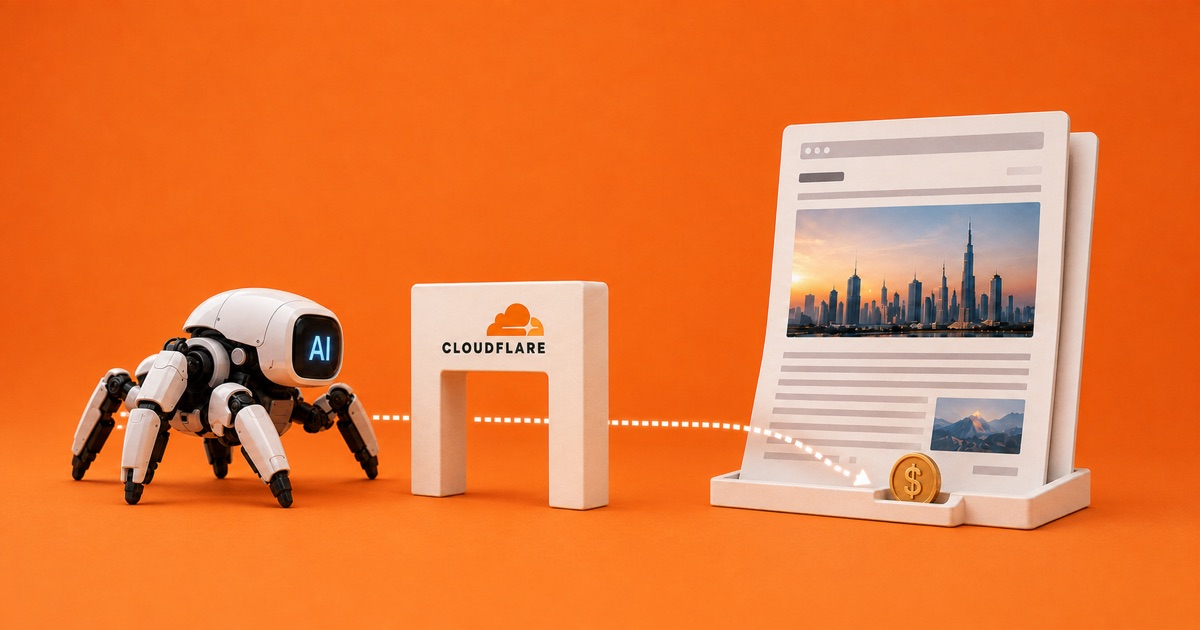
Cloudflare Pay Per Crawl lets publishers price AI access. Its newer Pay Per Use experiments ask a harder question: what is that content worth?
A crawler can collect a page without sending a reader to the publication that paid to produce it. Pay Per Crawl put a price on that visit. Now Cloudflare is testing payments tied to how AI services use the material, giving publishers another way to negotiate the exchange.
A page that supplies a useful answer could earn its publisher money even when nobody clicks through. Publishers gain a way to set terms for access, although the system cannot make a reluctant buyer pay. Google presents a particularly difficult test of that bargaining power.
Cloudflare helps websites deliver content and protect themselves from malicious traffic. Its service can sit between a website’s server and the people or bots requesting its pages, putting it in a position to control access. W3Techs detected Cloudflare on 25.1% of the websites it surveys as of September 7, 2026, roughly one in four.
That reach could help Cloudflare bring paid access to a large website base. If the model produces reliable income, publishers would have another reason to join Cloudflare or stay with it. The survey does not measure Pay Per Crawl participation or establish its contribution to Cloudflare’s market-share growth.
How Cloudflare Pay Per Crawl works
Pay Per Crawl lets participating website owners charge AI crawlers for access to their content. Cloudflare handles the transaction infrastructure and acts as the merchant of record. Its current documentation describes a closed beta, so publishers must apply to join.
A crawler can signal its willingness to pay when requesting a page. A successful paid retrieval returns the content with an HTTP 200 response. Otherwise, the service can return HTTP 402, or Payment Required, with pricing information.
Cloudflare sets a minimum price of $0.001 per successful retrieval. Publishers choose their default price and can use dynamic pricing for different content.
At that minimum, 1,000 paid retrievals would generate $1 in gross charges, before any applicable deductions. The calculation assumes every request qualifies for payment. Publishers need to know how many requests come from crawlers willing to pay before using bot traffic to estimate revenue.
The payout process also needs attention. Publishers must create a dedicated Cloudflare Stripe Connect account. Cloudflare’s payout documentation provides for monthly payments to publishers in good standing, subject to settlement periods and minimum thresholds. It also says publishers must request accrued balance updates from Cloudflare because the dashboard does not yet display them.
A crawl does not tell the whole story
Counting visits makes billing straightforward, but it leaves an awkward question about value. Repeated collection can run up a bill for material an AI service barely uses. A single retrieval could supply information that remains useful long after the crawler leaves.
Cloudflare acknowledged that problem in its July 1, 2026, Pay Per Use announcement. The company said it was starting to develop Pay Per Crawl into a broader system that supports different payment models, with experiments involving Ceramic.ai and You.com.
Ceramic’s model is designed to pay participating publishers when their content appears in its search results. You.com’s approach lets agents buy a specific piece of premium content on demand. Cloudflare described the work as experimental and said it still had to learn how these models would perform at internet scale.
For a publisher, the choice of payment event deserves as much scrutiny as the price. Payment for a retrieval, an appearance in a search result and access to a premium article each rewards a different action. The terms should make clear which one earns the fee.
Publishers have met this problem before
Digital Boom saw an earlier version of the distribution problem in 2015, when it contacted Hayot Films about a charity video spreading beyond its original YouTube upload. The producer welcomed the awareness but expressed disappointment about monetization as copies circulated on Facebook. Extra exposure did not automatically support the route intended to raise money.
AI search adds another reason to examine that exchange. Chartbeat data in the Reuters Institute’s 2026 industry report showed that aggregate Google organic search traffic to more than 2,500 sites fell 33% between November 2024 and November 2025. The report cautioned that it was unclear how much of that decline came from AI Overviews.
Those figures describe a group of publishers. They do not establish what happened to an individual site or how much revenue it lost. Editors should investigate the causes of a search-traffic decline before deciding that payments from AI services can close the gap.
Could paid access replace the money from those missing visits? The cited evidence does not establish that. A publisher would need to compare payments received with changes in advertising, subscriptions and other income over the same period. Counting crawler requests alone would miss most of the calculation.
Google leaves publishers with a difficult choice
A publisher can set a price and restrict access to its pages. Google can still decline the terms.
Google’s guidance on AI features in Search identifies Googlebot as the crawler control for Search, including AI Overviews and AI Mode. Google-Extended governs certain other AI uses, including Gemini training and grounding. Blocking Google-Extended does not separately switch off AI Overviews.
Publishers can limit what Search displays using preview controls such as nosnippet and data-nosnippet. Those controls offer no payment mechanism. A wider access restriction also reaches the search service publishers rely on for referrals.
Returning Payment Required to Googlebot creates a more direct risk. Google’s HTTP guidance treats 4xx responses other than 429 as unavailable content and removes affected indexed URLs over time. Under that documented rule, a 402 response risks losing search visibility rather than starting a paid transaction.
Cloudflare gives publishers a stronger way to withhold access. Their ability to use that power against Google still depends on how much search traffic they can afford to lose.
Start with the reporting someone would pay for
A publisher considering a trial should begin with material that would be difficult for a buyer to find elsewhere: an original interview with a regional investor, a detailed local market investigation, or a dataset the newsroom maintains itself.
A trial should show which material attracts paying demand and at what price. An AI service may find a substitute, decide the information is unnecessary, or decline the terms.
Access rules need the same care. Cloudflare says a block imposed through its firewall or bot-management products overrides a Pay Per Crawl charge rule. A publisher intending to sell access should check that it has left the chosen crawler a working way to pay.
The first commercial milestone is a payment the publisher can trace to a buyer and the activity that earned it. That gives the newsroom a starting point for deciding whether the income justifies offering more content on those terms.